


Send a message.
We’re here to answer any question you may have.
careers
Would you like to join our growing team?
careers@hub.com
careers
Would you like to join our growing team?
careers@hub.com
Quick summary: Somebody owes your business money and has stopped paying. What happens next depends almost entirely on one thing — whether the debtor has anything worth collecting. This page explains how a collection file actually moves, so you can find the stage you’re at and skip the rest.
The instinct, when an account goes bad, is to push harder. More calls. A sterner letter. Then a lawsuit, because that feels like the serious option.
But a lawsuit doesn’t produce money. It produces a judgment — a piece of paper saying you’re owed what you already knew you were owed. Turning that paper into a deposit takes a separate set of tools, and those tools only work if the debtor has something to take.
Which is why the order matters. Find out what’s there first. Then decide what to spend.
Aging is not neutral. Every month a file sits, it gets worse in ways that don’t show up on the aging report:
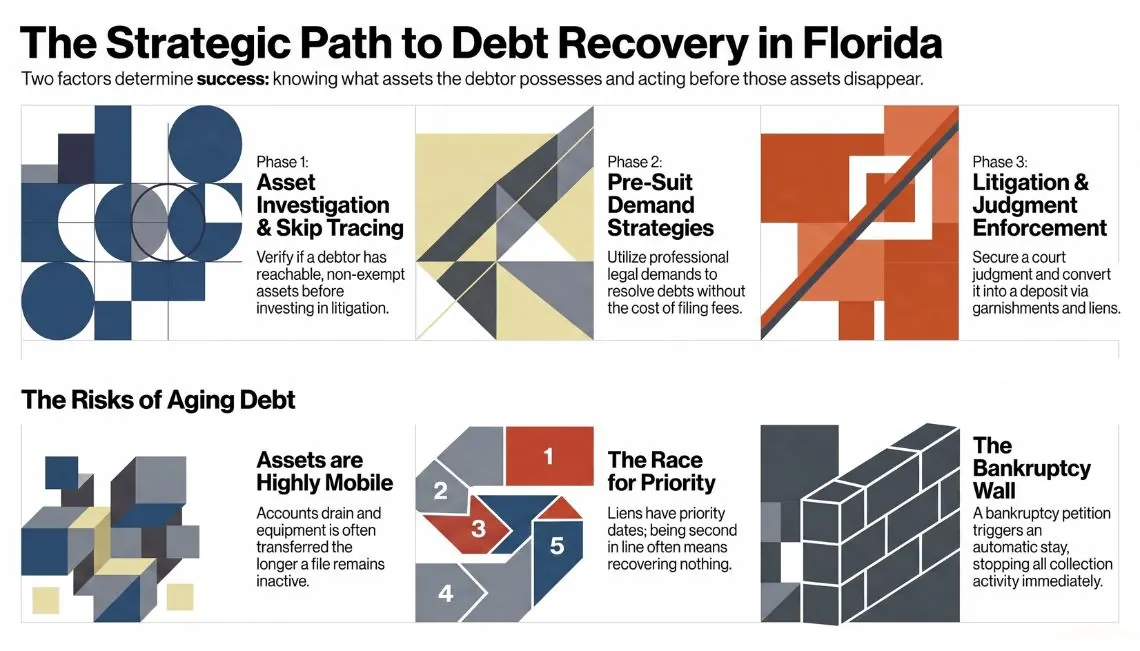 Where your file is right now
Four stages, in the order a file usually travels. Most matters don’t need all four.
You can’t find them, or you can find them but not their money. Locating debtors, identifying reachable assets, and finding out whether this file is worth pursuing before you spend anything on it.
Most debts that get paid get paid here. A properly drafted demand from a firm that actually litigates changes the debtor’s math without costing you a filing fee.
When the demand doesn’t land, suit follows. Breach of contract, open account, account stated, replevin to recover property, and the remedies that attach along the way.
You have the judgment and still no money. Wage garnishment, bank garnishment, levy on vehicles and equipment, judgment liens, and proceedings supplementary when assets have been moved.
Four files that don’t follow the standard path, because of who the creditor is or where the debt came from.
One business owes another. Contract disputes, unpaid invoices, open accounts and personal guarantees, where the counterparty is still operating and may still be worth a relationship.
You’re not placing a file, you’re placing a book. Volume placement, scoring and segmentation, reporting, and deciding what to work, what to sell and what to write off.
You paid the claim and now you’re standing in your insured’s shoes. Recovery against the party actually responsible, on the carrier’s timeline and reporting requirements.
You won somewhere else and the debtor or the assets are in Florida. A judgment from another state isn’t enforceable here until it’s domesticated — then every Florida remedy opens up.
A collection agency can call, write and report. It cannot file suit, take a judgment, garnish an account or open a proceeding supplementary. At the point the agency runs out of remedies, you need a lawyer — and we take placements directly from agencies as well as from creditors.
The other thing that happens to collection files is that they stop being collection files. The debtor files bankruptcy. The collateral turns out to be real property. The dispute grows into commercial litigation with counterclaims. At most collection shops, that’s where your file gets handed to somebody else and you start over explaining it. Kass Shuler has practiced creditors’ rights in bankruptcy, real estate and commercial litigation in the same building, in Tampa, for over four decades. The file moves down the hall.
And if the honest read is that a debt isn’t worth chasing, you hear that too. That answer costs you nothing further, which is more than an optimistic one can say.
Florida sets outside deadlines by claim type — written contracts get longer than oral ones, and the clock usually runs from the last payment or the breach, not the invoice date. But the practical answer is different from the legal one: recovery odds drop long before the statute does. If a file is aging, the question is worth asking now rather than at the deadline.
Not necessarily. “No visible assets” and “no reachable assets” are different findings, and debtors are not neutral reporters of their own finances. Asset investigation exists precisely because the answer is often somewhere other than where the debtor points. It’s also how you find out quickly if they’re telling the truth.
No. Open account and account stated claims exist for exactly this situation, and a course of dealing documented in email is evidence. A signed credit application with a personal guarantee and an attorney’s fee provision would give you more leverage, which is a good argument for fixing your paperwork going forward — but its absence doesn’t end the file.
Sometimes. Florida generally follows the American rule, where each side pays its own, but a contract provision or a specific statute can shift fees to the debtor. Whether you have one is one of the first things worth checking, because it changes what’s worth pursuing.
The automatic stay stops collection activity immediately, and the deadlines that protect your claim start running the same day. Missing them is how unsecured creditors end up with nothing. Creditors’ rights in bankruptcy is one of the firm’s seven practices, so the file changes hands internally rather than being returned to you.
Yes. Some clients place one invoice, others place a portfolio. What decides whether a file is worth working is collectibility, not size — a collectible small balance beats an uncollectible large one, and we’ll tell you which one you have.
Bottom line: the money is recovered or lost based on what the debtor has and how fast you move on it — not on how strongly your last letter was worded. Send us the file and you’ll get a straight read on what’s there.
Place a file · (813) 229-0900 · 1604 N. Marion St., Tampa, FL 33602 · Serving creditors statewide across Florida