


Quick summary: Your borrower filed. That doesn’t end your claim, but it does move it into a system with its own deadlines, its own priorities, and no tolerance for missing either. What you recover is largely decided in the first few weeks, by whether anyone protected your position while it was still there to protect.
What actually happens when the petition is filed
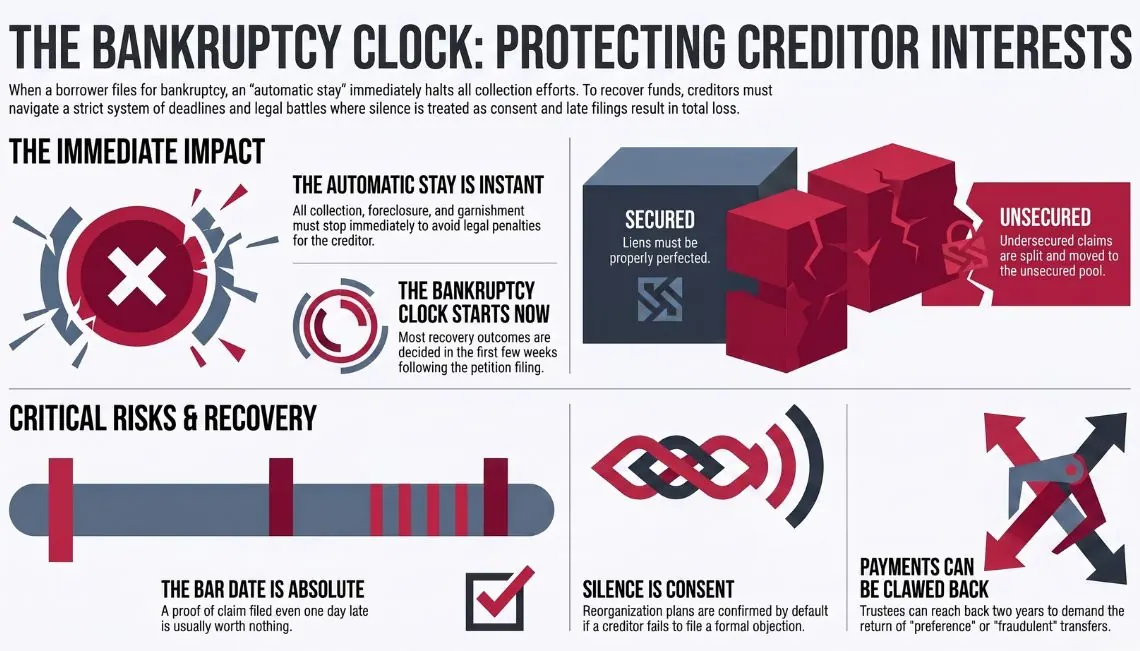
The automatic stay takes effect immediately. Collection stops. Foreclosure stops. Garnishments stop. Continuing to collect after notice — even by accident, even by an automated system nobody switched off — is itself a violation with consequences for the creditor.
At the same moment, a set of clocks starts running that determine what you get. Most creditors lose money in bankruptcy not because their claim was weak but because nobody was watching those clocks.
- Secured or unsecured is not a label, it’s a fight. Whether your lien is properly perfected, and what the collateral is actually worth, decides which pile you’re in.
- Undersecured claims get split. If the collateral is worth less than the debt, the shortfall drops into the unsecured pool with everyone else’s.
- The bar date is absolute. A proof of claim filed late is usually worth nothing, regardless of how valid the underlying debt is.
- Plans get confirmed by default. A plan nobody objected to binds you to its terms. Silence is consent.
- Payments you already received can be clawed back. Preference and fraudulent transfer actions reach backwards, and receiving a demand two years later is not unusual.
 What we do for creditors
- Stay relief and adequate protection. Getting you out from under the stay where the collateral is depreciating or there’s no equity to protect.
- Proofs of claim and claim objections. Filing yours correctly and challenging others that dilute the pool you’re sharing.
- Plan and confirmation objections. Contesting treatment, valuation, cramdown interest rates and feasibility before the plan becomes binding.
- Adversary proceedings. Dischargeability challenges where the debt arose from fraud or defalcation, lien validity disputes, and defending preference and fraudulent transfer claims brought against you.
- Workouts and restructuring. Negotiated outcomes outside the plan process, which are frequently better than what a plan would have delivered.
- Creditors’ committees. Representation on and advice to committees in Chapter 11 cases.
- Section 363 sales. Acting for buyers acquiring assets from a debtor-in-possession, and for creditors whose collateral is being sold.
- Creditors’ rights in transactions. Mergers, acquisitions and financings where a counterparty’s insolvency risk needs to be structured around rather than discovered later.
Why creditors bring these files here
A bankruptcy filing is almost never the first thing that happened. It’s the fourth. There was a delinquency, then a demand, then a collection suit or a foreclosure, and then the petition — and each of those stages produced facts that matter to what happens in the bankruptcy court.
When the bankruptcy goes to a new firm, all of that gets re-learned on your budget. Kass Shuler practices collections, mortgage default and creditors’ rights in bankruptcy in the same building, so the file that becomes a bankruptcy matter is usually a file we already know.
The firm appears as creditor’s counsel in all three of Florida’s federal districts — Northern, Middle and Southern — and has represented secured and unsecured creditors, financial institutions and asset purchasers for over four decades.
Common questions
We’re unsecured. Is it worth participating at all?
Often yes, and the cost of finding out is small. Filing a claim preserves whatever distribution there is. Beyond that, unsecured creditors can object to plans, serve on committees, and challenge dischargeability where the debt arose from fraud. The answer that costs you money is assuming there’s nothing to do.
The debtor paid us right before filing and now the trustee wants it back.
That’s a preference demand, and it is one of the more common shocks for creditors who thought the file was closed. There are recognized defences — ordinary course of business, contemporaneous exchange, subsequent new value — and whether they apply depends on facts about your own dealings with the debtor. Don’t pay it back on request without that analysis.
Can we keep collecting while the case is pending?
No. Once the stay is in effect, collection activity has to stop — including automated letters and calls. If you need to act against the collateral, the route is a motion for stay relief, not continuing and hoping.
Our lien is on the collateral. Doesn’t that protect us automatically?
Only if it’s properly perfected and the collateral is worth what you think. Both get tested in bankruptcy, and both are where secured creditors discover they are partly unsecured. Establishing the position early is what makes the rest of the case predictable.
How fast do we need to move?
Faster than most creditors expect. Several of the deadlines that matter run from the filing or from the first meeting of creditors, not from when the notice reached the right person at your organization. If a notice has been sitting in a queue, that is the thing to deal with today.
Bottom line: bankruptcy doesn’t extinguish your claim, it puts it on a clock. What you recover depends almost entirely on whether someone was watching that clock in the first few weeks.
Talk to us · (813) 229-0900 · 1604 N. Marion St., Tampa, FL 33602 · Serving creditors statewide across Florida
Related: Collections for Creditors · Mortgage Default Services · All services