


Quick summary: Default work is a pipeline, not a case. A loan goes delinquent and from that moment it is either moving or aging — through loss mitigation, foreclosure, sometimes bankruptcy and eviction, and out the other side as an REO closing. Kass Shuler runs the whole pipeline for banks, credit unions and servicers across Florida.
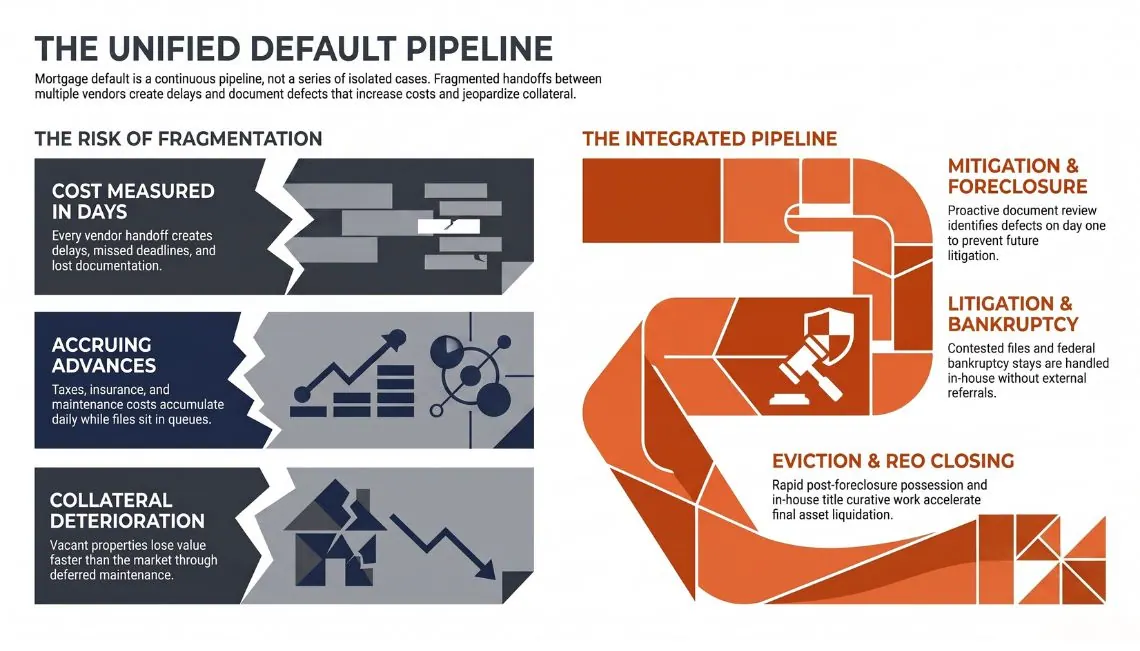
The problem with handing a default file around
Most default files change hands at least once. Loss mitigation is one vendor, foreclosure is another, the bankruptcy goes to a third when the borrower files, the eviction goes to somebody local, and the REO closing goes to a title company that has never seen the file.
Every one of those handoffs is a place where days get lost, a deadline gets missed, or the file arrives somewhere without the document that would have saved a month. And the cost of a default file is measured almost entirely in days.
- Advances keep running. Taxes, insurance, maintenance and corporate advances accrue for as long as the file is open, whether or not anything is happening on it.
- Timelines are scored. Investor and insurer expectations don’t pause because a file sat in a queue, and curtailment is a real cost with a real number attached.
- The collateral deteriorates. A vacant property loses value faster than the market does, and deferred maintenance shows up in the REO price.
- Every restart costs a review cycle. A file rejected for a document defect goes back to the beginning of somebody’s queue, not to where it left off.
- Contested files punish the unprepared. A borrower with competent counsel will find the assignment gap, the notice defect, or the payment history discrepancy — and those are cheap to fix early and expensive to fix at summary judgment.
 What we handle
Loss Mitigation
Alternatives to foreclosure, worked properly rather than as a box to tick. Loan modifications, assumptions, HUD assignments, repayment plans, short sales, payoffs, reinstatements and deed-in-lieu. The right outcome here is often cheaper for the lender than the right outcome in court.
Foreclosure
Uncontested and contested residential and commercial foreclosure statewide, across Florida’s circuit courts. Document review happens at the front of the file rather than when opposing counsel raises it, because the defects that kill a foreclosure are almost always visible on day one.
Foreclosure Litigation
The files that stop being routine. Contested trials, adversary proceedings and appeals, covering payment and escrow disputes, lender-placed insurance claims, standing and assignment challenges, and alleged RESPA, TILA and FDCPA violations. This is the part of the practice that most default shops refer out.
Bankruptcy
Creditor representation in all three of Florida’s federal districts — Northern, Middle and Southern. Motions for stay relief, adequate protection, valuations where lien stripping is at issue, plan and confirmation objections, and proofs of claim. When your borrower files, the file moves down the hall instead of out the door.
Evictions
Post-foreclosure possession, handled quickly because every day of occupancy is a day the asset can’t be marketed and can’t be inspected.
REO and Closings
Distressed sales, refinancings and modifications, with title services and curative work in-house. The firm acts as authorized agent for multiple title insurers, so a title problem discovered at the end of a default file gets solved rather than escalated.
Why one firm for the whole pipeline
Default files don’t stay in their category. A routine foreclosure becomes contested litigation when the borrower retains counsel. It becomes a bankruptcy matter the day a petition is filed. It becomes a title matter when the assignment chain has a gap. It becomes an eviction, and then a closing.
Kass Shuler has practiced foreclosure, creditors’ rights in bankruptcy, real estate and commercial litigation from the same Tampa office for over four decades. That combination is unusual, and on a default file it is the whole point: the file changes character several times and never changes firms.
It also means the answer you get about a file is a complete one. Whether to modify or foreclose, whether to fight the stay or wait it out, whether a title defect is curable — those questions get answered by people who will also be handling whatever comes next.
Common questions
Do you take referrals from servicers as well as lenders?
Yes. Banks, credit unions, servicers, sub-servicers and investors all place default work here, individually or in volume, with reporting built to fit the systems you already run rather than requiring you to adopt ours.
What happens when the borrower files bankruptcy mid-foreclosure?
The automatic stay halts the foreclosure immediately, and the deadlines that protect your lien position start running the same day. Because we appear as creditor’s counsel in all three Florida districts, the response is filed by the firm already holding the file, with the loan history already in hand.
Can you handle commercial default, not just residential?
Yes. Commercial mortgage default brings in guarantees, receiverships, rent assignments and often a workout negotiation that residential files don’t have — all of which sit alongside the firm’s commercial litigation and real estate practices.
What do you need to open a file?
The note, the mortgage and the assignment chain, the payment history, and whatever default notices have already gone out. If the assignment chain has a gap, we would rather find it in intake than in a motion for summary judgment.
The borrower is disputing the payment history. Is that a real problem?
It can be, and it is one of the more common reasons a routine file turns contested. Escrow analysis, lender-placed insurance and misapplied payments are all territory where a well-advised borrower can create genuine delay. Establishing early that the history holds up is cheaper than defending it later.
Bottom line: a default file costs you in days, and most of those days are lost at handoffs between vendors. Running the pipeline in one place is how you stop paying for them.
Talk to us · (813) 229-0900 · 1604 N. Marion St., Tampa, FL 33602 · Serving lenders and servicers statewide across Florida
Related: Creditors’ Rights in Bankruptcy · Real Estate · All services